


An independent expert?

An expert for the Task Force Therapeutics (which studies whether purchases of Covid medicines are appropriate), the FAMHP (Federal Agency for Medicines and Health Products) and the EMA[1](European Medicines Agency), Dr Nicolas Dauby has considerable influence on public health decisions.
Given his background, which we set out in detail in this article, can he still claim the independence that his duties as an expert require?
The best-known dimension of conflicts of interest is the rather basic one found in situations where an expert personally receives money or benefits in kind.
Yet there are other, less visible dimensions that steer decisions… not necessarily in the citizen’s interest.
Before the opinions of a small group of scientists shaped the life of a country, it would have been essential to check beforehand the factors likely to influence their recommendations.
Saint-Pierre Hospital
After looking into the conflicts of interest of the parliamentary experts[2] and of the KU Leuven[3], BAM! Investigation has explored behind the scenes at the ULB; and more specifically at the infectious diseases department of Saint-Pierre Hospital.
While Dr Yves Van Laethem enjoys a certain fame as interfederal spokesperson, other less publicised experts have a significant influence on health decisions.
Thus Dr Nicolas Dauby, an infectious disease specialist, holds several strategic positions. We will show that the interests he may have in some of them are incompatible with the neutrality he ought to have in the others.
The Institute for Medical Immunology and Arnaud Marchant
Tracing his biography chronologically, one can see that Dr Dauby’s link with the pharmaceutical sector seems to have been established fairly early in his career, since he began a doctoral thesis at the Institute for Medical Immunology (IMI). This institute is the result of a partnership between the ULB, the pharmaceutical company GSK[4] and Wallonia. This institute was – and still is – headed by Arnaud Marchant and, as we will show, this information is of great importance.

To continue his work and carry out a fifth year of research at the IMI, in 2013 Dr Dauby applied for a grant from the Horlait Foundation[5], whose president at the time was Professor Yvon Englert, a gynaecologist and former rector of the ULB who was appointed “Mr Vaccination” for Wallonia[6]. Dr Dauby’s application for this grant was supported by Arnaud Marchant, as can be seen in the letter of recommendation he sent to Prof. Englert[7].


There is obviously nothing reprehensible about a research director lending a young doctor the support of his network to obtain a grant. Nevertheless, the professional ties established with the Institute for Medical Immunology (co-founded by GSK) and with Arnaud Marchant from the very beginning of Dr Dauby’s career are still continuing today. He states on his Twitter account: “Researcher in immunology and vaccination during pregnancy @ Marchant’s Lab”. His membership of the team is also confirmed directly on the IMI website[8]

Why is this problematic in the context of the SARS-Cov2 epidemic?
Vaccinopolis
It should be known that Arnaud Marchant is, together with Pierre Vandamme, the promoter of the project to create a new centre for clinical studies on vaccines. The creation of this centre was already announced in May 2020, when Belgium was barely emerging from the first wave of the Covid epidemic[9]. We learn that the Belgian government invested 20 million euros in this centre and that the other 20 million euros needed were provided by foundations, including the Bill and Melinda Gates Foundation[10].

Ground was broken in January 2021[11] and Franck Vandenbroucke attended the inauguration of Vaccinopolis in March 2022[12]:
“Building a centre like Vaccinopolis is quite a feat. Under normal circumstances, a DBM project of this kind takes four to five years to complete”, explains Kevin De Hainaut (Cordeel). “But exceptional circumstances call for exceptional measures: COVID-19 is proof that viruses can strike quickly and by surprise. All the project partners joined forces to drastically reduce the completion time.”

That our federal government should invest 20 million euros in the middle of a pandemic to build a centre for clinical studies on vaccines might seem good news… Several things are nevertheless regrettable:
- Once again, we see that all the financial effort is directed solely towards a vaccine solution, and it is hard to understand why the government did not invest at the same time in clinical studies on outpatient treatments. When an epidemic is so serious that the government ends up issuing measures with such an impact on every aspect of citizens’ lives, would it not be imperative to try to fight it by every possible medical means, including by investing in research on care and outpatient treatments?
- On the other hand, the immunology branch of this Vaccinopolis will be headed by Arnaud Marchant, whose laboratory was co-founded in partnership with GSK, a pharmaceutical company which has also entered the race to develop a vaccine against the coronavirus[13], which has just been finalised. When an expert like Dr Dauby works in a laboratory partly owned by a pharmaceutical company developing a vaccine, can he really claim to be free of conflicts of interest? All the more so as the director of his lab is working flat out to create a huge centre for clinical research on vaccines.
Public-private partnerships
Public-private-university partnerships are increasingly numerous and are sometimes presented as an economic advantage for the country. Thus, in this article[14] published on Cairn-Info, we can read:
“The way companies operate in terms of research has changed in recent years: in the pharmaceutical industry, for example, the large laboratories concentrate on their core business, which is the manufacture of medicines, while upstream in the chain they work more and more frequently with smaller laboratories, or even university research centres. It is only once new molecules have been identified in university laboratories that partnerships are set up, with the large firms then taking over to carry out development and clinical studies with a view to manufacturing the medicines.
Public authorities’ awareness of the economic importance of research has moreover increased very markedly in recent years, at the different levels of power (from the European Union to the federal, community and regional levels). In order to maximise the economic returns on the efforts made, the value of networking companies’ research and innovation initiatives has also been highlighted in the different regions of the country.”
But when a crisis like the one we have been going through for more than two years arises, the choice of the experts who will take decisions concerning the health of all citizens should be made with great care. In particular, by ensuring their total neutrality, so that their medical guidelines can in no way be influenced either by their personal ideology or by the fact that the future of their professional career depends on the decisions they will advise taking.
As regards personal ideology, it is easy to see that Dr Dauby is a fervent advocate of vaccination since, at a symposium organised by the FAMHP on 6 December 2019[15], he gave a presentation on the societal impact of vaccination[16]. In short, he explains that vaccination offers an excellent return on investment, an opinion he also explained on the television channel LN24 in September 2019.

Of course, every doctor is free to have a scientific opinion and to advise patients according to the convictions he has formed over time.
Where this becomes a problem in the case at hand (which is far from an exception among official experts) is when, through another position held, this personal opinion steers crucial public health decisions.
Task Force Therapeutics
Indeed, Dr Dauby is a member of the Task Force Therapeutics[17], a group of experts appointed to draw up recommendations for the care and treatment of patients. Their opinions are intended to become the scientific reference followed by all doctors caring for patients. Their responsibilities are immense, because how patients’ condition evolves depends on the quality of their recommendations. Their most absolute neutrality is a fundamental condition for guaranteeing the best care for patients. The interest of patients must be their one and only priority. And the doctors who rely on the experts’ recommendations are entitled to expect this total scientific neutrality from them.
The question to ask is: would mass vaccination still be necessary if effective early treatment existed?
Will GSK’s return on investment in developing a vaccine (which they announce will cover all variants) not be all the greater the more massive vaccination is?
What would its profits be if the number of people really needing a vaccine were limited to those at risk of developing a severe form?
How urgent would the creation of a centre like Vaccinopolis be if general practitioners and other front-line carers had a protocol making it possible to save many lives by treating patients?
Lack of transparency
In connection with his role on the Task Force Therapeutics, Dr Dauby filled in his declaration of conflicts of interest without mentioning his research work in Arnaud Marchant’s laboratory (co-founded by GSK) as a potential conflict[18].


Yet the stakes are such that it is legitimate for citizens, doctors and patients alike, to demand that all members of the Task Force Therapeutics be totally independent of any tie likely to constitute pressure of any kind.
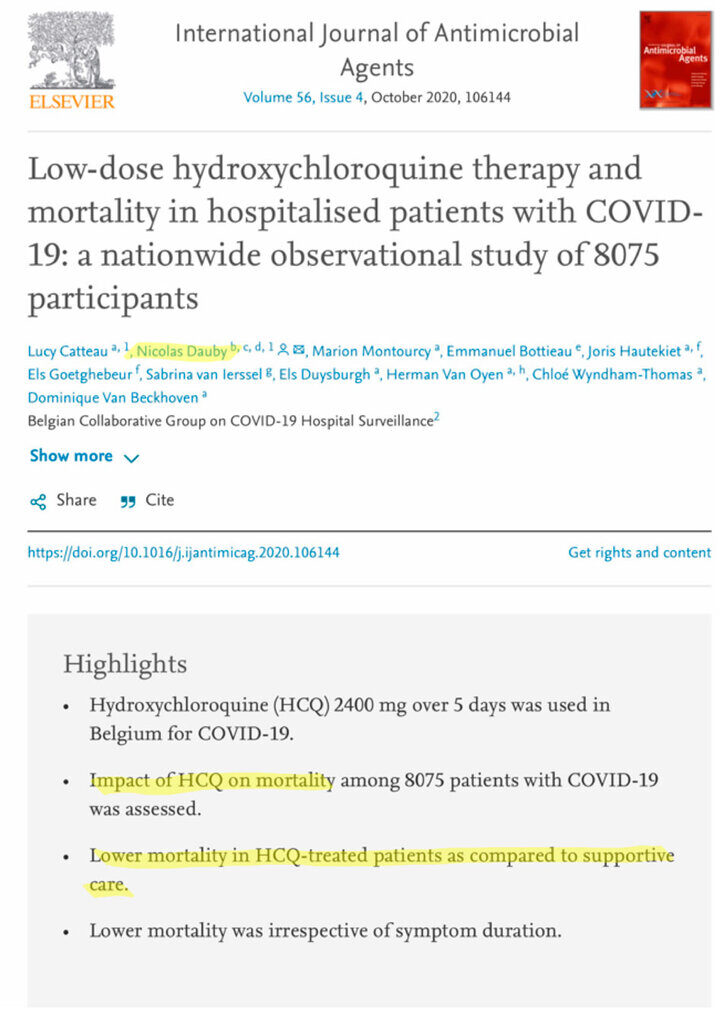
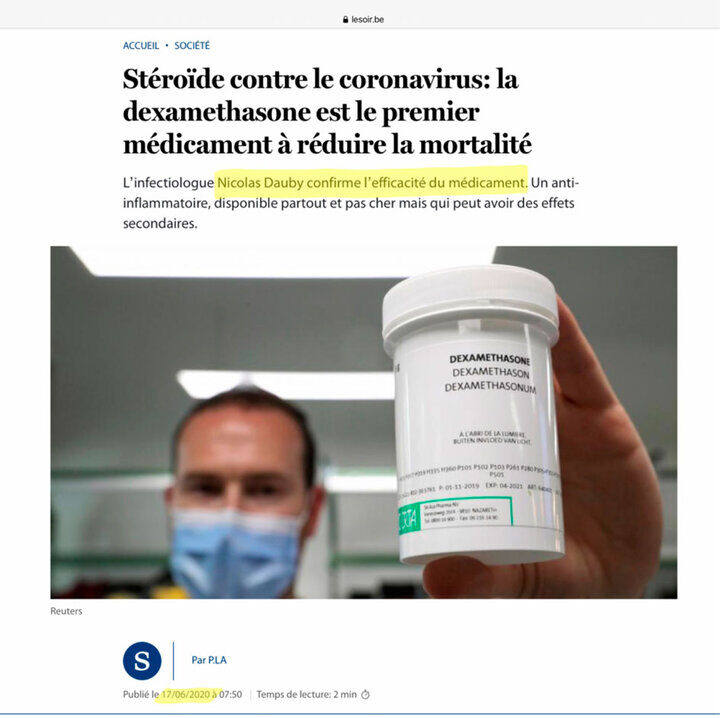
How then can one explain, other than by pressure, the fact that Dr Nicolas Dauby, after conducting a study[19] on the use of hydroxychloroquine in Belgium concluding that it was effective in reducing mortality, then took a position against the use of this molecule? This study is moreover featured on the Sciensano website[20], which describes it as demonstrating a reduction in mortality in hospitalised patients to whom it had been prescribed. The same questions can be asked about corticosteroids, of which he nevertheless said in June 2020 (see article in Le Soir[21]) that they were the first medicines likely to reduce mortality.



Complaint to the Medical Council
How else, other than by conflicts of interest due to his work as a researcher at the Institute for Medical Immunology, alongside Arnaud Marchant, promoter of the Vaccinopolis project, can one explain that Dr Dauby, once the vaccines appeared on the market, began comparing doctors who advocate early treatment to the Brazilian President Bolsonaro? Is this not excessive? The violence with which he attacks colleagues who say publicly that outpatient care is essential for how patients fare demonstrates his lack of neutrality. He even went so far as to file complaints with the Medical Council against some of them, reproaching them for advocating the use of oxygen at home.

He even felt obliged to write to the RTBF newsroom following the publication of an article relaying an interview with one of his colleagues, a general practitioner, who described her experience in the field[22], stating that he had filed a complaint against her.

(BAM! Investigation kept the screenshot of this note at the bottom of the article published by the RTBF, although it was deleted less than 24 hours later.)
One may wonder what harm Dr Dauby thinks he has suffered to justify filing a complaint against colleagues who exercised their freedom of prescription by choosing to treat their patients with antibiotics, corticosteroids or oxygen. How would this not constitute good medical practice in the case of respiratory infections likely to become superinfected, degenerate into an inflammatory storm and put patients in a state of hypoxia? And this when he himself had announced, in an article in Le Soir, that corticosteroids reduced mortality in 30% of cases.
Article 7 of the code of medical ethics[23] specifies that: “In the care relationship, the doctor’s professional independence is expressed through his therapeutic freedom”.
What, then, can motivate a young doctor to file a complaint against older colleagues more experienced in general medicine? If it really were a matter of bad practice with serious consequences for their patients, would it not be up to those patients, or their relatives, to complain to the Medical Council? If none of the patients treated suffered any harm, it is hard to understand why a doctor would challenge the therapeutic freedom of some of his colleagues.
All the more so as there is a very clear outpatient care protocol[24], developed by the KCE, which includes the use of antibiotics, corticosteroids and oxygen. Admittedly, at the outset, this protocol was recommended in the event of hospitals being saturated. But why should experienced general practitioners wait for hospitals to be overloaded before treating Covid patients according to a protocol that corresponds to the most recent scientific data?
Indeed, Article 4 of the law of 22 April 2019 on the quality of healthcare practice states that “the healthcare professional is guided, in his choice referred to in paragraph 1, by relevant scientific data and his expertise, while taking into account the patient’s preferences.” This law came into force on 1 July 2021.
When he writes to the RTBF to dispute that there could be alternatives to vaccination, can one not fear that his motivation may originate in the ties of interest he has formed with the IMI and the brand-new Vaccinopolis?
Has he himself respected Article 7 of the code of medical ethics, which requires doctors to ensure that they remain independent?

Scientific expert at the FAMHP and the EMA
To complete the list of positions held by Dr Dauby, we will add two that deserve to be mentioned. In addition to being a member of the Task Force Therapeutics and a researcher in immunology-vaccinology, he is also a scientific expert for the evaluation of vaccines[25] at the FAMHP (Federal Agency for Medicines and Health Products) and a member of the scientific committee at the EMA[26] (European Medicines Agency).
As everyone knows, these two institutions are responsible, among other tasks, for checking the safety of pharmaceutical products. In his declarations of conflicts of interest[27], there is no mention whatsoever of his work as a researcher in Arnaud Marchant’s laboratory at the IMI.
Is it compatible to be both in a position to recommend mass vaccination (with no other alternative, in his view) and in a position to evaluate the safety of the products one recommends? Is this not being both judge and party at the same time?
Is there not a great risk of ignoring pharmacovigilance signals that could call into question his responsibility in promoting vaccination for all, including pregnant women?
Could the consumer’s interest really be guaranteed if the owner of Ferrero were at the same time an influential member of the AFSCA (Belgian food safety agency)?
For BAM! Investigation, the question must be asked and the information must be brought to the public’s attention. Because patients and doctors alike have the right to know who dictates medical recommendations, in order to be able to judge whether the independence required by such a role is really applied. We believe that if doctors knew about these potential conflicts of interest, they would probably be more circumspect, taking care to show caution and detachment by also seeking information from other sources.
In short: experts’ conflicts of interest do not exist only in the form of money, as the case of the very influential Dr Nicolas Dauby illustrates.

By BAM! Investigation
[1]https://www.ema.europa.eu/sites/default/files/ContactsAndExperts_CVs_and_DOIs/daubyn_DI_en.pdf
[2]https://bam.news/en/articles/parliamentary-experts-under-influence
[3]https://bam.news/en/articles/ku-leuven-and-private-funding
[4]Institut d’immunologie médicale, IMI
[5]https://www.horlaitfoundations.be/IMG/pdf/DAUBY-ULB-DOSSIER.pdf
[6]Yvon Englert: « Il est important de se faire vacciner pour se protéger, pas pour plaire à Jan Jambon » - Le Soir
[7]https://www.horlaitfoundations.be/IMG/pdf/DAUBY-ULB-DOSSIER.pdf
[8]https://cvchercheurs.ulb.ac.be/Site/unite/COM203.php
[9]La Belgique investit dans un centre de tests de vaccins - Santé - LeVif
[10]La Belgique va multiplier les essais cliniques accélérés pour les vaccins | L’Echo
[11]Building Group Jansen - Vaccinopolis ouvrira ses portes dans quatorze mois
[12]https://vandenbroucke.belgium.be/fr/vaccinopolis
[13]Coronavirus : le vaccin de Sanofi et GSK enfin prêt, reste à demander le feu vert des autorités sanitaires - rtbf.be
[14]Les acteurs de la recherche en Wallonie et à Bruxelles | Cairn.info
[15]2019 Archives présentations | AFMPS
[16]https://www.afmps.be/sites/default/files/content/09_societal_impact_of_vaccination.pdf
[17]Liste des membres de la Taskforce - KCE
[18]https://kce.paddlecms.net/sites/default/files/2022-01/COI_FR%20TFx_DAUBY.pdf
[19]Low-dose hydroxychloroquine therapy and mortality in hospitalised patients with COVID-19: a nationwide observational study of 8075 participants - ScienceDirect
[20]Association entre hydroxychloroquine et mortalité des patients COVID-19 hospitalisés en Belgique | sciensano.be
[21]Stéroïde contre le coronavirus: la dexamethasone est le premier médicament à réduire la mortalité - Le Soir
[22]La pandémie au jour le jour, entre provax et antivax : une médecin verviétoise témoigne - rtbf.be
[23]https://gcm.rmnet.be/clients/rmnet/content/medias/codecom-20190808.pdf
[24]https://kce.fgov.be/sites/default/files/2021-11/Decision-aid-Worrisome%20patient-FR_01062021.pdf
[25]Nicolas Dauby | VIB Conferences
[26]https://www.ema.europa.eu/sites/default/files/ContactsAndExperts_CVs_and_DOIs/daubyn_DI_en.pdf
[27]https://www.afmps.be/sites/default/files/content/DOI/dauby_nicolas_doi_2018.pdf
Photo source:
BAM! screenshot of the website of the RTBF


