


RTBF: What we must think

Four years to the day after the release of “Ceci n’est pas un complot”, Bernard Crutzen shares his thoughts on Arnaud Ruyssen’s podcast “Les Clés”, broadcast last week on the RTBF. In this op-ed, he invites journalists to ask themselves whether they have been misled by their sources.
Last Thursday, a friend told me that my documentary “Ceci n’est pas un complot” was being discussed on La Première (RTBF). I listened to the “Les Clés” podcast, presented by Arnaud Ruyssen, on catch-up, and I was surprised: I did not recognise the excerpts from my own film! I then realised that the “Clés” team had made a mistake, which I hope was unintentional: they had used the statement of intent[1] announcing the crowdfunding campaign in early October 2020, and not excerpts from the documentary, released in February 2021.
I do not disown what I said in that statement of intent, but my position had evolved by the time the film came out. The anger that dominated in October had turned into indignation. The commentary was more nuanced; I had understood how much the media were being misled by their sources (I will come back to this later). The media discourse had also evolved somewhat: the press was more critical of the disastrous handling of the 2nd wave, while still believing that the vaccine would mean a return to normal.
Today, four years to the day after the release of “Ceci n’est pas un complot”, what remains is a feeling of disappointment and powerlessness: I was not heard by journalists.
The podcast series “Covid, 5 ans après” gives the impression that the authorities and the press are trying to justify their mistakes. “At the time, we didn’t know” is the phrase that keeps coming back like a mantra. But the use of “we” is not correct. Some specialists knew, some carers were sounding the alarm; they were not listened to. On the contrary, they were blacklisted, ridiculed and sometimes prosecuted by those who thought they were closest to “the truth”.
Arnaud Ruyssen is undoubtedly the most nuanced journalist at the RTBF, and I agree with him when he says: what I also paid a great deal of attention to during this crisis was the humility of experts, their ability to acknowledge that there were certain things they didn’t know. So I find it hard to understand why he let his guest Xavier Counasse display such assertiveness in the episode devoted to the media. Several times, the Le Soir journalist hammered home: “That’s false!” in a peremptory and final tone. I would like to invite him to show a little more nuance. To help him, I have dissected a few claims heard in the podcast “Covid : les médias ont‑ils été suffisamment critiques ?”.
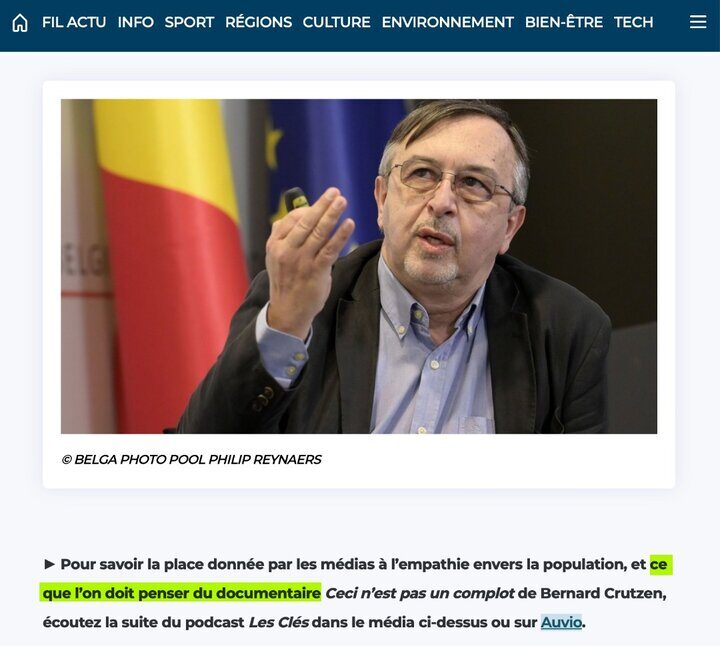
- Let us note from the outset that the RTBF shows its hand in the article[2] on RTBF Actu inviting people to listen to the podcast. It reads: to find out what we must think about Bernard Crutzen’s documentary “Ceci n’est pas un complot”, listen to the rest of the podcast… Is the RTBF entitled to tell us what we MUST think? By using this verb, it seems to admit that free will is reserved for its journalists, most of whom come from the Université Libre de Bruxelles, the self-proclaimed temple of free will. Must we, readers and listeners, necessarily think like the journalists of public television?

- Invited by Arnaud Ruyssen, Jean‑François Raskin (former director general of IHECS and former chairman of the RTBF board of directors) argues in one of his contributions that the media lacked empathy. This remark made Arnaud Ruyssen and Xavier Counasse jump in unison. Excerpt from the podcast:
19 min 16 sec. Arnaud Ruyssen: I can’t let you say that, because empathy, precisely, and going out to gather the testimonies of all those who were struggling with the measures, that was done a lot.
I agree with Arnaud Ruyssen: the media did show empathy towards a population subjected to mask-wearing, social distancing, bubbles, curfews and lockdowns. But the press very rarely openly criticised the merits of these measures. Far from empathy, it was rather contempt that the media showed towards any sceptical or dissenting position. In the podcast recorded 5 years after the crisis, Xavier Counasse still displays rare ferocity towards those who questioned the measures, such as Bernard Rentier or Elisabeth Paul. And I am not spared ( see below).
- 22 min 23 sec. (Arnaud Ruyssen) I’d like you to hear a few excerpts from a documentary that made a lot of noise at the time. A documentary called “Ceci n’est pas un complot”, which was not broadcast by the mainstream media, but which made its way on social media, on the web (…)
(Sarah Poucet)
(…) Freely published on Vimeo and YouTube in early February 2021, it very quickly racked up thousands of views, eventually passing the million mark.
A little fact‑checking:
The film was also broadcast by a mainstream media outlet: NoTélé, the television station of Wallonie picarde. It reached 1.9 million views across different platforms.
- 23 min 16 sec. (Sarah Poucet) For 1 hour 10 minutes, we see a succession of clips from TV news bulletins or newspaper headlines about the pandemic. An accumulation of very short excerpts that never really allow you to grasp the context of the interview or the point being made as a whole.
That is a criticism that could be levelled at any documentary, any report and even at the “Les Clés” podcast, since it is precisely short excerpts from TV news bulletins or interviews that illustrate Arnaud Ruyssen’s points. Nobody today broadcasts long excerpts from interviews any more, for fear that the viewer or internet user will switch off.
- 24 min 34 sec. (Bernard Crutzen, excerpt from the statement of intent) Let no one ever tell me again that the press is a counter-power! I want to make this film because I am still angry.
As I said above: the excerpts broadcast in this podcast come from the statement of intent[3], and not from the documentary, as Arnaud Ruyssen announces. Four months passed between the writing of this statement of intent and the release of the film. After meeting dozens of people, my commentary was less heated.

- 26 min 41 sec. (Xavier Counasse) I just can’t understand the responsibility of the traditional media in the formation of the alternative media… I don’t know if I should call that media, because I’ve seen them go by, eh, these sites, and I watched it all the way through, the piece, the documentary, it makes me… I think the word is too strong for me to repeat it, by Mr Crutzen…
Mr Counasse chokes as he utters these words and is mistaken: a documentary may be broadcast by a media outlet, but it is not a media outlet. And the Le Soir journalist does not seem to know the difference between a news report and a documentary. “Ceci n’est pas un complot” takes the form of an investigation because the film seeks to confront what the media said with reality. But like any documentary, it has an authorial point of view, a stance stated from the outset.
- (Xavier Counasse) That has nothing informative about it. These aren’t media. There’s... I wanted to start fact‑checking this documentary. I had so many points, I said to myself: this is going to take 25 days!
25 days? Only a dozen or so points have been fact‑checked by other media outlets (L’Echo[4], Libération…) And these are mainly differences of opinion and not fake news, as Xavier Counasse implies. I would be happy to give my answers and my sources to the Le Soir journalist.

- 27 min 09 sec. (Xavier Counasse)
I probably have better things to do to inform our readers. Sorry for this little digression, but I think at some point, what people expect from us is added value, investigation…
Did Xavier Counasse investigate his own sources? During the Covid crisis, many press releases came from the Reuters agency, the largest Western news agency, with 2,500 journalists and 200 regional bureaus.
On the official website of the Pfizer laboratory, you can find the members of the board of directors, including a certain James C. Smith[5]. In his biography, we discover that Mr Smith was CEO of the Thompson‑Reuters Corporation until 2020. Thompson‑Reuters notably owns the Reuters news agency. One can easily imagine that Mr Smith would prefer information unflattering to Pfizer to be distributed by Reuters with less haste than the lab’s good results. Even if, of course, the agency’s newsroom will proclaim its independence.
At the end of 2021, the Reuters agency flooded us with information about the South African variant, insisting on its very high contagiousness and much less on its low morbidity. A godsend for Pfizer!
Here in Belgium, the microbiologist Emmanuel André, a frequent presence on the RTBF TV news, regularly relayed Reuters press releases on his Twitter account. The microbiologist stood out for his particularly aggressive tweets against dissidents and had repeatedly accused me of being a confirmed liar. He left Twitter‑X 2 weeks ago. So as not to leave any trace of his positions, now that the wind is turning?
But let us return to Mr Smith. Here, then, is a man who, in 2020, was CEO of a company overseeing the largest news agency in the world, while at the same time sitting on the board of directors of Pfizer. I imagine that in the whirlwind that swept the press away at the start of the health crisis, Xavier Counasse did not have time to check his sources. But since then?

- 37 min 00 sec. (Xavier Counasse)
We have to keep being critical. We obviously have to question ourselves, but we do ask ourselves questions, we do it.
I do indeed encourage Xavier Counasse to ask himself questions. Notably about the reliability and disinterestedness of his sources. For weeks, the journalist relayed in the pages of Le Soir the number of “cases” (when they were in fact positive tests) and the number of Covid deaths worldwide, presented in infographics. These statistics cheerfully mixed deaths from Covid and deaths with Covid; this was only made clear much later.
The source of these statistics was mentioned in Le Soir: it was “Our World in Data”, which relied on data aggregated by John Hopkins University[6]. You have to dig a little to realise that behind the University’s prestigious facade there is in fact a private school, the Bloomberg School of Public Health[7], funded by the billionaire philanthropist Mike Bloomberg[8]. The very same man who has just announced that his Foundation would take over the funding of climate measures following the American withdrawal from the Paris Agreement.
I have been subscribed to the John Hopkins School of Public Health newsletter for 4 years. At the slightest isolated case of contagion by any virus, in any corner of the planet, John Hopkins urges the authorities to take drastic measures. The institution constantly brandishes the spectre of pandemics to influence policymakers and to ask for donations for its work. It is also behind several simulations, including the famous “Event 201”, which took place in New York in October 2019[9], two months before the discovery of SarsCov2. This exercise, sponsored by the World Economic Forum (Davos) and the Bill&Melinda Gates Foundation with the blessing of the WHO, was based on the hypothesis of the spread of a coronavirus and the global response to it. Around the table: epidemiologists, UPS, Lufthansa… but no carers. On the other hand, the line-up of this event included a security specialist, who stressed the importance of muzzling social networks so that no one could contradict official information. Yet a few weeks ago, the boss of Meta (Facebook, Insta…) admitted[10] that during the Covid crisis he had received instructions from the American authorities to censor any post that questioned official communication.
By inviting Xavier Counasse to speak about the media’s behaviour during the health crisis, did Arnaud Ruyssen expect the Le Soir journalist to be so worked up, five years on? I share the sense of frustration of these two journalists: when you have stepped out of your comfort zone to inform people as well as possible, when you have not counted your hours, and perhaps put your family life at risk, it is hard to accept criticism. In that respect, I am with them, because I too have sacrificed a great deal. But I believe they are both angry at the wrong thing. What they feel, still confusedly, is that they were misled by their sources and allowed themselves to be drawn into what will one day appear as the greatest health scandal in human history.
Bernard Crutzen
Documentary film-maker.
The opinions expressed in this article are solely those of the author and do not necessarily represent those of BAM!
Standfirst by BAM!
[1] Ceci n’est pas un complot NOTE d’INTENTION.
[2] 5 ans de Covid‑19 : les médias ont‑ils été suffisamment critiques durant la crise sanitaire ? - RTBF Actus
[3] Ceci n’est pas un complot NOTE d’INTENTION
[4] For example, the one by L’Echo: Ceci n’est pas un complot, mais ceci prend des libertés avec les faits | L’Echo
[6] Edouard Mathieu and Lucas Rodés‑Guirao (2023) - “Our World in Data will rely on data from the WHO to track confirmed COVID‑19 cases and deaths” Published online at OurWorldinData.org. Retrieved from: ’Our World in Data will rely on data from the WHO to track confirmed COVID‑19 cases and deaths’ [Online Resource]
[7] Johns Hopkins Bloomberg School of Public Health
[8] Mike Bloomberg | Johns Hopkins
[9] Event 201 Pandemic Exercise: Highlights Reel
[10] Mark Zuckerberg affirme que la Maison Blanche a fait "pression" sur Facebook et Instagram pour censurer des contenus sur le Covid‑19
