


The reality “not detectable” by Sciensano

In Sciensano’s weekly report dated 25 March 2022, the table of the vaccine’s relative reduction in the risk of infection shows “not detectable” 9 times out of 12.
BAM!-DETOX*
BAM!-DETOX analyses what lies behind this new term, which is taking on the look of an epidemic.
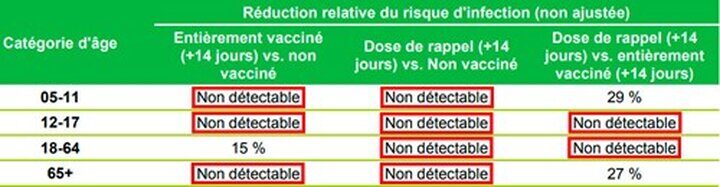

Source: covid-19 bulletin épidémiologique hebdomadaire - (25 mars 2022) - page 24
What does this table mean?
The vaccine’s relative reduction in the risk of infection gives an estimate of the vaccine’s effectiveness against infections (positive cases).
In the table above, 15% means that unvaccinated people aged 18 to 64 are 15%, or 1.15 times, more likely to test positive than vaccinated people (without a booster dose).
The figures for the relative reduction in the risk of infection are calculated on the basis of the 14-day cumulative incidence of cases* found in the same report (see graph below).
|
* Incidence relates the absolute number of cases to the target population in order to make comparison easier (vaccinated, unvaccinated, ..). For example, a 14-day cumulative incidence of 739.8 among the vaccinated means that on average 739.8 cases were detected per 100,000 vaccinated people over a period of |
How is this risk of infection calculated?
To calculate, for example, the figure of 15% (fully vaccinated +14 days vs. unvaccinated for 18-64 year-olds), we take the incidence (Sciensano graph below) of unvaccinated 18-64 year-olds (867.8) and subtract the incidence of vaccinated 18-64 year-olds (739.8), i.e. 867.8 - 739.8 = 128. Then we divide by the incidence of unvaccinated 18-64 year-olds (the same 867.8), i.e. 128 / 854.8 = 0.1474994238303757, or 15% when rounded.

Source: covid-19 bulletin épidémiologique hebdomadaire - (25 mars 2022) - page 24
Let’s recalculate the whole table
We therefore took Sciensano’s incidence figures to recreate the table of the vaccine’s relative reduction in the risk of infection.

Download the Excel spreadsheet (in French)
We do indeed find the 15%, 29% and 27% shown in Sciensano’s original table, which confirms that our calculation matches Sciensano’s.
Finally, we copy the result in red onto Sciensano’s table:

What do these negative values mean?
A negative figure means that a vaccinated person is more likely to be infected than an unvaccinated person.
For example, -171% means that a vaccinated person over 64 is 2.71 times as likely, i.e. almost 3 times more likely, to be infected than an unvaccinated person.
We also see that this problem also exists, though to a lesser extent, among young people: 1.7 times more risk among vaccinated 5-11 year-olds (-69%) and 1.65 times more among vaccinated 12-17 year-olds (-65%).
The booster dose seems to make this phenomenon even worse among 18-64 year-olds (-53% compared with the vaccinated).
The only ones still spared are vaccinated 18-64 year-olds (15%) and boosted people aged 65 and over (35%), 5-11 year-olds (29%) and 12-17 year-olds (24%). In all other cases, the unvaccinated fare, as far as infections are concerned, from better (19%) to much better (171%).
What can we conclude?
In general, we see that vaccination tends to increase the circulation of the virus over time. This is corroborated by greater circulation of the virus after vaccination observed in many countries (e.g. Israel, USA, England, Iceland, Gibraltar).
It should also be noted that this phenomenon appears over time and that, while vaccination seemed to reduce infections 14 days after the injection, we know that this protection is short-lived (6 months for Delta and 3 months for Omicron) and that it now has an overall negative impact on infections.

Here we see on a graph from the Sciensano dashboard that the most vaccinated municipalities (towards the right) are also those with the highest number of cases per 100,000 inhabitants (towards the top).
Source: Belgium COVID-19 Dashboard - Sciensano
Although changes in the rules (Covid Safe Ticket) and in testing strategies mean that the progression of cases over time must be analysed with caution, the phenomenon that seems to be confirmed, and which is more worrying, is the worsening over time of the risk of infection among the vaccinated; the nature, evolution and duration of this problem being still unknown to date.
We currently have no definitive explanations, but certain hypotheses could partly explain this phenomenon:
- Persistence of enhancing antibodies greater than that of neutralising antibodies[1]. This phenomenon has been observed with certain vaccines against the dengue, yellow fever and Zika viruses and ultimately led to their abandonment.
Regarding Sars-Cov2, observed in the laboratory (in vitro); this hypothesis has been neither refuted nor scientifically confirmed in a living being (in vivo). - Selection of variants that bypass vaccine immunity and find a competitive advantage in the vaccinated, among other things via the enhancing antibody phenomenon mentioned above.
In any case, even if vaccination still seems to show relative effectiveness against severe forms (a few “not detectable” also appear in the admission figures[2]), it is absolutely necessary to take the time to study this phenomenon before continuing with mass vaccination. It is not reasonable to play yo-yo with a population’s immunity when a large part of it runs a limited risk from the virus.
Biased institutions and unfounded decisions
Until scientists find a definitive explanation for this phenomenon, Sciensano has a duty not to conceal but to warn the authorities and the public with full transparency.
The figures above clearly show that the measures and decisions taken to achieve a reduction in transmission among the vaccinated have no scientific basis. The Covid Safe Ticket or mandatory vaccination for health workers can in no way be justified by a reduction in infections among the vaccinated. On the contrary, these figures show that vaccination carries an increased risk of contamination over time.

Source: Missions de Sciensano | Coronavirus Covid-19
Finally, this biased presentation of the figures shows once again that Sciensano, whose mission is to inform, is not a neutral and independent institution, but a body with opaque funding (BAM! will come back to this in a forthcoming article), whose aim is to convince the authorities, health professionals and the public, with a scientific veneer, that they must get vaccinated, even if it means masking reality.
Beyond the divisions, discrimination and sanctions justified by truncated data, the misleading presentation of the facts will lead to citizens’ legitimate loss of trust in their institutions.
[1] Facilitation de l’infection par des anticorps — Wikipédia
[2] covid-19 bulletin epidemiologique hebdomadaire - (25 mars 2022) : 25 pp.
* BAM!-DETOX brings together university professors, doctors, people working in the pharmaceutical and medical field and independent journalists. BAM!-DETOX aims to analyse and verify the information circulated in the media and on social networks.