


Vaccination Task Force (Part 2): The manufacture of scientific consensus

When we watched the video of the webinar given to general practitioners by Jean-Michel Dogné, about which we wrote this first article[1], one element caught our full attention and deserves some clarification.
BAM!-DETOX*
Since the publication of our first article “The Vaccination Task Force rediscovers science (Part 1)”, the video “A booster dose for a peaceful holiday: epidemiological situation”, on which our two articles are based, has been removed from the website of the Société Scientifique de Médecine Générale.
Fortunately, BAM! saved a copy of this “collector’s item”.
https://crowdbunker.com/v/4Lcn3DMFfY
The fallacious loop of self-referencing and self-validation
When the recommendations for the future vaccination campaign were discussed (4th dose to start during the summer for the most vulnerable and to be planned more widely for everyone over 50 in the autumn), (minute 37) Jean-Michel Dogné used a linguistic trick that conceals (deliberately or not) what may be called “the self-referencing loop”.
What does this mean?
Let us go back to the exact sentence:
“We come to the recommendations, which are those of the Superior Health Council and which have been taken up by the Vaccination Task Force…”
Phrased this way, the listener is led to think that the recommendations Jean-Michel Dogné is about to state come from an outside body (the SHC) and have been validated by another outside body (the Vaccination Task Force), thereby becoming a consensus established between different bodies.
Without detailed knowledge of the composition of each of these bodies, the impression given is therefore that Jean-Michel Dogné is a messenger passing on the fruit of the collegial reflection of a large number of different scientists.
Yes, but…
What he fails to point out is that he is a member of the Superior Health Council[2] (he was appointed for a 6-year term by Ministerial Decree[3] on 13 May 2022). Nor does he point out that he is also a member of the Vaccination Task Force[4].

Why not put it this way: “At the SHC, we drew up recommendations which we took up at the Vaccination Task Force”?
Why distance himself in this way from decisions in which he took part within these two bodies?
Is it because he is aware that justifying his opinion by referring to his own opinion would greatly reduce his credibility? As when the authors of scientific publications self-cite by citing their own articles as references?
Or because it prevents the doctors listening to the webinar from realising that, in the end, decisions are taken in a kind of closed circle, by a limited number of people, and that they therefore represent only the vision of these few people, always the same ones?
We obviously cannot comment on Jean-Michel Dogné’s conscious and unconscious intentions in his choice of wording. But we find it striking that he omits to mention his membership of the SHC and the Vaccination Task Force. All the more so as, at the beginning of the webinar, the organiser introduced him by mentioning only his role as vaccine safety consultant to the WHO[5].
But what percentage of doctors know the exact composition of the various entities set up expressly to manage the epidemic?
Is it deliberate that neither the webinar presenter nor Jean-Michel Dogné took the trouble to mention his many other hats? Were they afraid that the participants might understand that the famous “scientific consensus” is perhaps only a manufactured consensus, made possible solely by the exclusion of scientists outside these decision-making bodies who might express different opinions?
A recurring phenomenon
It should be pointed out that Jean-Michel Dogné is not the only expert to use this kind of wording, suggesting that the information he passes on comes from an outside body from which he merely receives instructions without taking part in it. Thus, in this article[6] in Le Soir, on the decision not to suspend vaccination with the AstraZeneca vaccine, which we will come back to later, Yves Van Laethem uses the following sentence: “The Superior Health Council gave us a very clear opinion this Monday. It believes that the public health interest – at the very moment when we are starting to vaccinate the most vulnerable people, those over 65 – far outweighs the potential risk.”
The Superior Health Council gave US an opinion… says Yves Van Laethem, as if he were not part of the SHC that gave this opinion… Whereas one can read in this opinion that he is even its chairman.
But let us return to the multiplicity of hats worn by a single expert, which seems to us to pose another problem as well: that of self-validation.
For Jean-Michel Dogné, in addition to being part of the WHO Advisory Committee on Vaccine Safety, the SHC and the Vaccination Task Force, is also a pharmacovigilance expert at the FAMHP[7] and an expert at the European Medicines Agency (EMA).
Which means that, in addition to helping to define vaccination strategy, he takes part in evaluating the effectiveness of vaccine safety.
One and the same person recommends a product AND is responsible for evaluating the safety of the product he recommends. This cancels out decades of good management practice, which require “management” and “inspection” to be independent of each other, failing which we open all our decision-making processes to arbitrariness and to financial and mental corruption. This illustrates the indispensable separation of powers in an open and democratic society. This is therefore one more deception, and these loops of self-citation are the very antithesis of scientific activity itself.
Let us take this illustrative example among others:
- In the media (here, on RTL[8]) on 9 February 2021, Jean-Michel Dogné talks about the effectiveness of the AstraZeneca vaccine (administration of this vaccine began in early December 2020 in England).
- In early March 2021, a number of cases of thromboembolic side effects had been reported, mostly by England. The term thromboembolic events is to be taken in a broad sense, all types combined, including the fatal side effect of cerebral venous sinus thrombosis (STT), three cases of which subsequently occurred in Belgium[9].
- On 7 March 2021, Austria decided to suspend the administration of a specific batch of the vaccine. On 11 March, Denmark applied the precautionary principle and suspended vaccination with AstraZeneca, followed by Norway and then other European countries, including France.
- On 11 March 2021: the FAMHP published an opinion[10] entitled: “no concern at present about thromboembolic events with the AstraZeneca COVID-19 vaccine, the study is ongoing at European level”. FAMHP publications are never signed, so the name of the person who wrote this one is unknown, but it will be noted that the sentences are exactly the same as those Jean-Michel Dogné would use two days later when explaining the Belgian decision in the media.
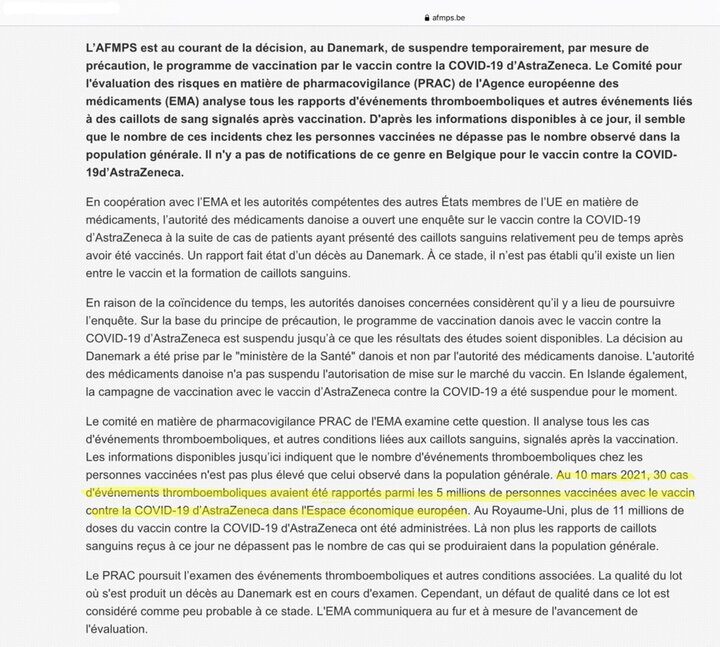

- Also on 11 March, as an expert at the European Medicines Agency, Jean-Michel Dogné was put in charge of analysing these events and reporting on them[11], a report that would be closed on 19 March.

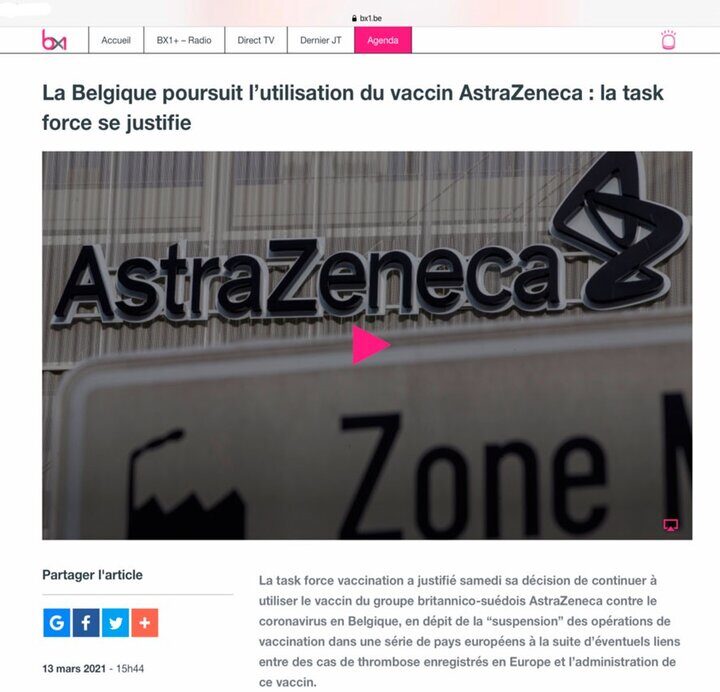
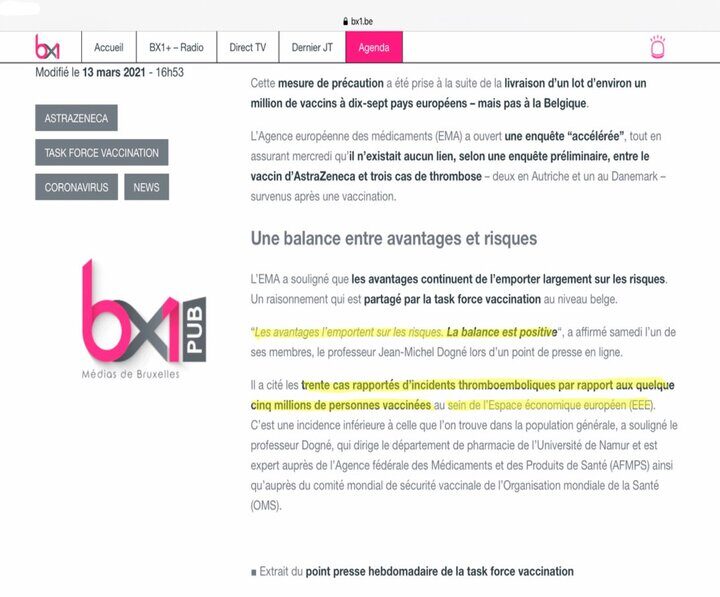
- On 13 March, Jean-Michel Dogné, representing the Vaccination Task Force, explained at an online press briefing[12]: “The EMA stressed that the benefits continue to far outweigh the risks. A reasoning shared by the vaccination task force at Belgian level: ‘The benefits outweigh the risks. The balance is positive’, one of its members, Professor Jean-Michel Dogné, said on Saturday at an online press briefing. He cited the thirty reported cases of thromboembolic incidents compared with some five million people vaccinated within the European Economic Area”. So on 13 March 2021, Jean-Michel Dogné was already stating that the EMA considered the benefit-risk balance to remain favourable, whereas the warning signal had only been recognised on 11 March and the EMA report would only be closed on 19 March. How could he already be certain that the conclusion would be favourable? Probably because he was the one in charge of this report and already knew what he was going to conclude…
- Meanwhile, in Belgium, following a question put on 14 March by the Health Minister’s office, the SHC (of which Jean-Michel Dogné is a member) replied on 15 March and confirmed on 19 March[13]: “Despite the suspension of the administration of the AstraZeneca vaccine by many European countries and pending the recommendations of the EMA, Belgium continued its vaccination campaign with all the vaccines at its disposal, while remaining attentive to the occurrence of possible adverse side effects at Belgian level (FAMHP4) and a fortiori at European level, keeping itself continuously informed of the scientific and official communications (WHO5, EMA) published throughout the week. Indeed, the SHC experts were of the opinion that even a provisional suspension of this vaccination could only have harmful effects on Covid-19 vaccination in general, post-vaccination thromboembolic phenomena being present in the same order of frequency as with the Pfizer/BioNTech vaccine according to the information available at that time.”


So the only European country not to apply the precautionary principle by suspending – at least provisionally – the use of an AstraZeneca vaccine is precisely the country where the expert in charge of the report for the EMA is a member of the Scientific Council…
What did the Belgian SHC know that the scientific councils of other countries did not?
Had Jean-Michel Dogné already decided on 11 March that his report for the EMA would present a conclusion in favour of continuing to use this vaccine?
And, while he was justifying this Belgian decision in the media as early as 13 March by explaining that there had only been 30 reported cases of thromboembolic accidents out of more than 5 million people vaccinated, in the European report he was writing at the same time he indicated that there had been, in England: “258 serious cases”, including “45 deaths” (the number of less “serious” thromboembolic side effects is not mentioned).

What should we make of this omission regarding the English data?
Why cite only the 30 cases reported in Europe as at 11 March without mentioning the 45 deaths in England? And why not say that, of these 30 European cases, there were 7 deaths?
At the press briefing, was Jean-Michel Dogné afraid of worrying the population by mentioning these 45 + 7 deaths?
All the more so as, as at 11 March, Belgium had only just begun using the AstraZeneca vaccine, and it would have risked sending a bad signal to the population if the campaign had been interrupted very shortly after it began.

Is it not conceivable that his analysis report as an expert for the EMA reached a conclusion minimising the risks, so that the recommendation not to suspend the vaccination campaign in Belgium, in which he took part, would not be regarded as a mistake?
And despite the EMA’s favourable opinion based on Jean-Michel Dogné’s report, Denmark decided to stop the AstraZeneca vaccine permanently in April 2021, followed by Norway in May 2021 and Austria in June 2021. In Belgium, on the other hand, the campaign continued until the end of August 2021.
And while there were no reports of thromboembolic side effects in the FAMHP report dated 9 March, we see that already in the following week’s report, dated 16 March[14], the first Belgian case of thrombocytopenia is reported.
We can also read in the summary of the report Jean-Michel Dogné wrote for the EMA that the warning signal had been confirmed by Belgium.


Which means that when he closed his report on 19 March, he was perfectly aware that there had already been a death due to this specific side effect in Belgium.
In the FAMHP report of the following week, a second case of thrombocytopenia – a drop in the blood platelet count, which generally causes “bruises” but also cerebral micro-haemorrhages – is also reported.

Use of the AstraZeneca vaccine stopped gradually, without fanfare and without official explanation, but it was already in May 2021[15] that Europe announced it would no longer order this vaccine, giving as a reason that it was not sufficiently effective against the new variants.
In total, in Belgium, there will be 4 cases, including 3 deaths, of thrombocytopenia officially recognised as attributable to the AstraZeneca vaccine, the first of which occurred shortly before the SHC’s decision to continue the campaign and the closing of Jean-Michel Dogné’s report for the EMA. The second occurred a week later.
In Europe, there will be a total of 189 deaths due solely to this side effect, described as extremely rare by Jean-Michel Dogné. And it is difficult to count all the other serious cases and deaths caused by the other thromboembolic complications. To date, for example, 327 deaths from pulmonary embolism have been reported in Europe. And given the difficulties of pharmacovigilance reporting, these figures are more than likely underestimates. Moreover, in epidemiology, raw statistics (which make it possible to say that these effects are ‘rare’) have no value; it is odds ratios that must be calculated, but that would take us too far from our subject. Jean-Michel Dogné is not an epidemiologist and would do well to be more careful in his statements outside his field of experience.
Furthermore, on a strictly medical level, it would be good, even indispensable, to ask whether it is justified to use these products in people with hypercholesterolaemia (because of an increased risk of thrombosis) or with coagulation disorders – should Jean-Michel Dogné, a pharmacist and “thrombosis expert” (as listed on his LinkedIn page), not recommend caution because – he must know this – ALL medical products come with contraindications and precautions, two precise terms that have a medical and also… legal meaning.


The hat changes, the opinion remains
When the question of conflicts of interest is raised, there is a tendency to consider only financial issues.
But these are not the only conflicts of interest that exist.
When one and the same person wears so many different hats, it is inevitable that the decisions taken in some roles will bias the positions taken in other roles because, inevitably, the opinion that pushes someone to act in a certain direction in which he believes will remain the same opinion when he finds himself in another of his roles.
It is the hat that changes, not the ideas.
And when one faces such a level of responsibility – giving recommendations that will have a major influence on the health of millions of people – even if one realises that one may have made a bad decision, the consequences of such a mistake would be so heavy that it is human and almost understandable that, with the other hat, one does what is necessary to protect oneself. Did Einstein himself not say that a problem cannot be solved by the person who created it?
The Latin maxim “Aliquis non debet esse judex in propria causa, quia non potest esse judex et pars” translates as “No one should be judge in his own cause, because one cannot be both judge and party” and means that one cannot deliver a fair decision when one has an interest in the decision delivered.
This expression shows that it has long been known that the multiplication of roles with contradictory objectives is a major obstacle to impartiality.
Would one give credit to the nutritional recommendations of the head of the AFSCA (Belgian food safety agency) if he were at the same time the owner of a McDonald’s or a shareholder in Buitoni? Would a peer-reviewed study have any scientific value if its author were responsible for evaluating it?
Total independence between the role of recommending a pharmaceutical product and the role of evaluating the safety of that product should be a fundamental and unavoidable requirement, to prevent the evaluator from seeking to protect his interests and reputation as a member of a decision-making body rather than the interests of citizens.
For how many serious side effects and deaths could have been avoided if the evaluation report for the EMA had been entrusted to a pharmacovigilance expert not involved in the decision to continue vaccination despite the warning signal?
And it is legitimate to think that experts who, like Jean-Michel Dogné, use phrases such as “The SHC recommended that we…” or “The EMA report indicates that…” while omitting to point out their personal involvement in these bodies are aware that their many hats constitute a serious breach of their duty of independence and ethics.
Ultimately, the Dogné case is merely the symptom of rather worrying problems:
- Since these standards and codes are no secret to politicians, lawyers or professional bodies such as the Medical Council, how is it possible for such abuses to occur with complete impunity?
- How is it that public bodies took the responsibility of appointing people like Jean-Michel Dogné despite the most elementary ethical rules?
In the absence of concrete answers to these questions, the ability of public services to ensure the interest of citizens, and citizens’ trust in institutions, will remain wishful thinking.
[We will discuss the standards and the code of ethics in the 3rd and final part of this triptych]
By BAM! Detox
[1] BAM! News - The Vaccination Task Force rediscovers science (Part 1)
[2] Experts qui font partie du Conseil Supérieur de la Santé
[3] https://www.health.belgium.be/sites/default/files/uploads/fields/fpshealth
[4] Avis de la Task Force au sujet de la future stratégie de vaccination pour 2022
[5] Jean-Michel Dogné, expert pharmacovigilance auprès de l’AFMPS
[6] https://www.health.belgium.be/astrazeneca_ema_lettre_avis_urgente_2.pdf
[7] https://nouvelles.unamur.be/upnews.2012-09-04.5967332546/view
[8] https://www.rtl.be/info/video/771814.aspx
[9] Un troisième décès lié au vaccin AstraZeneca en Belgique - L’Avenir
[10] Coronavirus : pas d’inquiétude actuellement ...
[11] COVID-19 Vaccine AstraZeneca - Embolic and thrombotic events - PRAC Rapp AR & recommendation
[12] La Belgique poursuit l’utilisation du vaccin AstraZeneca : la task force se justifie - BX1
[13] https://www.health.belgium.be/astrazeneca_ema_lettre_avis_urgente_2.pdf
[14] https://www.afmps.be/Summary%20Tabulation%20AZ%202021%2003%2016.pdf
[15] Covid-19 : l’Union européenne ne commandera plus de vaccins AstraZeneca
* BAM!-DETOX brings together university professors, doctors, people working in the pharmaceutical and medical field and independent journalists. BAM!-DETOX aims to analyse and verify the information circulated in the media and on social networks.
Photo source:
Image cropped from the original image by twinsterphoto on AdobeStock


