
Syria: Chaos and Persecution

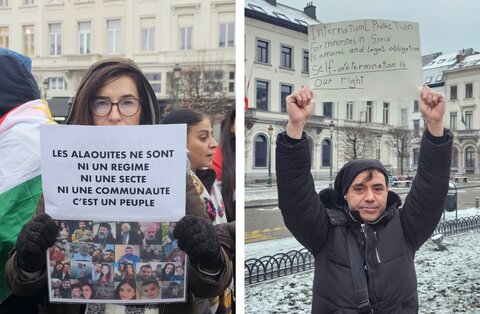
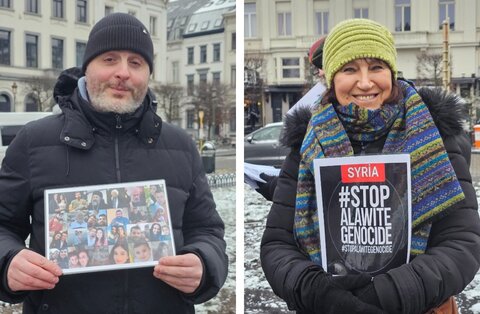
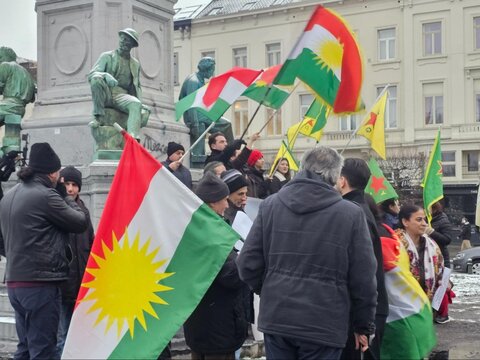
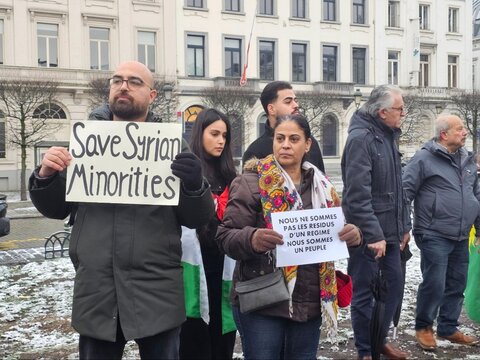
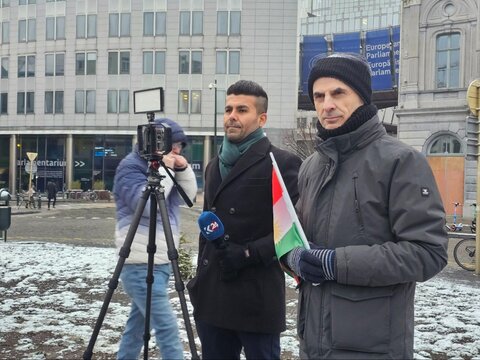
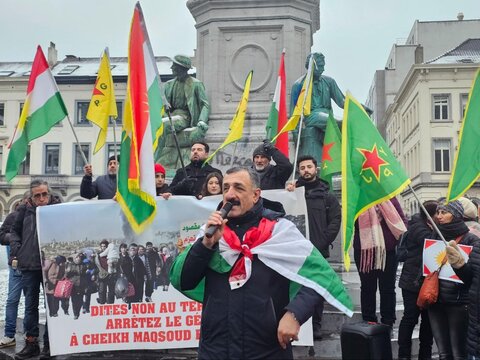
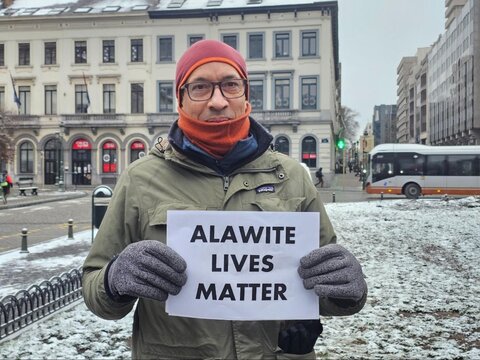
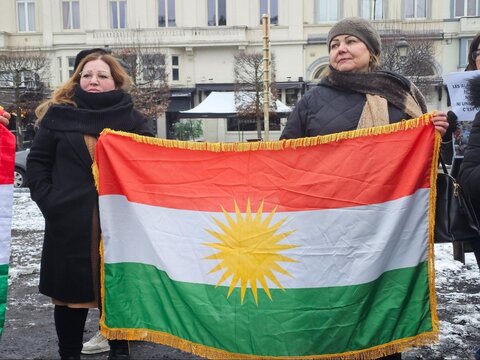
The Committee for the Support of Syrian Alawites and the Union of Syrian Alawites in Europe, in cooperation with the Syrian Democratic Forces and representatives of the Kurdish minority, have called for a demonstration this Saturday, January 10, at Place du Luxembourg, to demand urgent international protection for Syrian minorities. BAM! went to the scene to gather statements from the spokespersons of these movements.
Since the outbreak of the 2011 uprisings, in the wake of the Arab Spring, Syria has been spiraling deeper and deeper into violence (between 500,000 and 600,000 deaths[1], including more than 300,000 civilians according to the UN[2], 13 to 14 million displaced Syrians, representing more than half of the pre-2011 population), where political lines have gradually become intertwined with deep sectarian divisions. In addition to a Christian community on the verge of extinction and new waves of Kurdish displacement, particularly following the recent bombings around Aleppo, other groups remain at risk. Among them are the Alawites, an ethno-religious minority from which Hafez al-Assad’s family hailed, heavily represented in the army and pro-regime militias. Between human losses and the flight of young men to avoid conscription, their population has fallen from 2 to 2.5 million before 2011 to approximately 1.5 to 2 million today. Consequently equated with the regime—from which some have benefited—they have become targets far beyond the circles of power. From the earliest stages of the conflict, kidnappings, targeted assassinations, and abuses have punctuated their daily lives.
Yet, from 1970 to 2011, Syria had experienced nearly forty years of authoritarian stability under the Assad era. This stability, founded on strict security control and the systematic repression of the opposition, benefited several external actors. First the Soviet Union, then Russia, found a reliable ally in the Middle East, while Iran saw Damascus as a strategic link connecting Tehran to the Lebanese Hezbollah. Although predominantly Sunni, Syria served as a central link in the Shiite axis. This alliance had expanded by joining forces with the Palestinian resistance, notably the Sunni Hamas, forming a so-called non-sectarian “resistance” (Muqawama) axis opposed to Israel.[3]
This structure collapsed with the civil war. While Moscow eventually ceased its political support for the regime, Russia nevertheless retained its essential strategic interests, notably its naval and air base at Hmeimim, near Tartus, ensuring a lasting presence in the eastern Mediterranean.
Violence on a New Scale
Violence targeting the Alawites intensified after Bashar al-Assad fled into exile in Moscow, before crossing a new threshold in the spring of 2025. In March, a desperate attack attempt led by the last loyalists of the former regime served as the trigger for a wave of massive reprisals. Since then, kidnappings and summary executions have multiplied. The number of victims, mainly civilians, is estimated at between 1,000 and 1,400 people.
“About ten Alawites are murdered every day: dying under torture in detention, targeted by extrajudicial executions carried out by death squads traveling on motorcycles or in pickup trucks, mob attacks and lynchings, attacks, pogroms, or murdered during interrogations reminiscent of the Inquisition: ‘Are you Alawite?!’ Answer! If the answer is yes, the victim may be executed on the spot. Often the Alawites are recognized by their executioners by their last name, their place of birth, or their accent.” says Bahar Kimyongoür[4] of the CSAS, and author of “The Necropolis of Happy People, Memories of Antioch,” a novel on the history of the Alawites. See our exclusive interview.
Indeed, for the most radical groups—often direct or indirect heirs of the former Al-Nusra—the Alawites are not merely supporters of a despised regime: they are considered heretics, apostates, and “enemies of God.” This theological framework legitimizes violence that makes little distinction between combatants, former officials, and ordinary civilians.
The new government, however, claims to want to break with the practices of the past. The current authorities have initiated public legal proceedings against individuals from both sides suspected of committing abuses, whether former members of the regime’s forces or new government forces accused of summary executions. Presented as a sign of neutrality, these legal developments are struggling, however, to convince the Alawite population, whose distrust remains deep. In December, several demonstrations denouncing the violence and demanding protection were forcibly dispersed, resulting in new casualties.
The Actors Behind the Fall and Regional Calculations
The fall of the Syrian regime cannot be understood without analyzing the regional dynamics that accompanied—and even accelerated—it. Among the key players is Recep Tayyip Erdoğan’s Turkey, whose involvement was decisive, as Donald Trump was still keen to emphasize in late September[5]. From the earliest years of the conflict, Ankara supported various armed opposition groups, all while pursuing a consistent goal: to prevent the emergence of an autonomous Kurdish entity, particularly in Rojava, and to extend its influence to the southern fringes of its territory. The West was not to be outdone, with a European embargo on Syria in place as early as 2011; we also recall the “good work” on the ground implied by Al-Nusra, according to Laurent Fabius[6],[7], as well as the U.S. operation and the influx of weapons via Timber Sycamore from 2012 to 2017, as well as training camps in Jordan and Turkey, substantial funding from Saudi Arabia and Qatar, and likely tactical support provided by the IDF and other Western military officers.
Syria, an oil-exporting country, was a fairly developed and wealthy nation until 2011. The economic blockade imposed by the U.S. and Europe gradually brought the country’s economy to a near standstill. A devastating economic weapon that played a major role in breaking Syria’s will to resist, and which has been used very effectively in the past against other designated targets of the United States, even if 500,000 children were to perish, as Madeleine Albright said regarding neighboring Iraq[8].
To date, only Russia—despite facing far harsher sanctions—has been able to withstand such measures while avoiding fatal isolation.
This policy has contributed to the lasting fragmentation of Syria, to the indirect benefit of another major player: Israel. For Benjamin Netanyahu’s government, the disappearance of Baathist Syria represents a clear strategic advantage. Although largely Sunni, the Syrian state occupied a central place in what is referred to as the “Shiite axis,” not because of its religious demographics, but because of the political role played by its government. The Assad regime, drawn from the Alawite minority—a heterodox branch of Islam historically linked to Shiism through the figure of Ali, the son-in-law of the Prophet Muhammad—ensured territorial and logistical continuity between Shiite Iran and the Lebanese Hezbollah. The Sunnis’ return to power has weakened this strategic alliance and redefined the regional balance without Israel having to engage in direct military confrontation.
In this context, the gradual advance of Israeli forces beyond the Golan Heights accelerated. On December 8, 2024, the IDF broke free from the 1974 agreements to return to the Quneitra region, where it took control of Mount Hermon, overlooking southern Syria and the approaches to Damascus.[9] This advance carries strong symbolic weight: Mount Hermon was celebrated as a Syrian national glory, notably through the Panorama Museum of the October War, dedicated to the October 1973 war when Syria and Egypt attacked Israel during the Yom Kippur holiday.
Although no official acknowledgment has been made by the parties involved, talks between the emissaries of Benjamin Netanyahu and Ahmed Hussein al-Sharaa (who has already abandoned his nom de guerre, al-Joulani, which referred to the Golan from which his family was displaced in 1967) are continuing in Paris with the aim of stabilizing the front lines and formalizing a lasting military neutralization of Syria.
A relatively isolated community
The Alawites were separated in 1938–1939 when France handed over Antioch and the Alexandretta Sanjak to Turkey, which renamed it Hatay, where 500,000 to 700,000 Alawites live. In this context, the Alawites find themselves politically isolated. Nevertheless, there is a strong community of 15 to 20 million people in Turkey that expresses constant solidarity with them: the Alevis. Historically persecuted, theologically close, and bearers of a collective memory of sectarian violence, the Alevis are particularly sensitive to the plight of the Syrian Alawites, whom they perceive as a mirror of their own vulnerability.
|
|

As in Libya or Iraq, the fall of an authoritarian regime does not necessarily lead to justice or reconciliation, particularly when neighboring powers coordinate to expand their “security” zones into Syrian territory by stoking tensions between communities. In the chaos that followed the collapse of the Syrian state, sectarian divisions were stoked. This new theological framework legitimizes violence that makes little distinction between combatants, former officials, and ordinary civilians, all in the service of geopolitical and ideological agendas. Amid regional ambitions, strategic calculations, and religious radicalization, their fate illustrates one of the darkest aspects of the Middle East’s transformation: that of a minority trapped in a war whose stakes far exceed their capacity to comprehend, and whose outcome remains deeply uncertain in a regional context marked by strong external influences, just as in Iran in recent days, resulting in numerous new victims.
Réginald de Potesta de Waleffe for BAM!


[1] More than 500,000 dead since 2011: in Syria, the heavy toll of 14 years of war
[2] Syria: more than 306,000 civilians killed in ten years of conflict, according to the UN
[3] Iran after October 7: the “Shiite Crescent” and the “Axis of Resistance” — interview with Vali Nasr
[4] Bahar Kimyongür — Wikipedia
[5] ‘He Took Over Syria’: Trump Heaps Praise On Erdogan, Says He Should ‘Take Credit’ For Toppling Assad
[6] Bashar Al-Assad and France’s flip-flops (Le Monde diplomatique, December 2015)
[7] Laurent Fabius and the “good work” of the Al-Nusra Front in Syria: the story of a misquoted remark
[8] The Death of 500,000 Innocent Children Is Worth It - Madeleine Albright
[9] Israel says its troops in Syria will remain atop Mt. Hermon indefinitely | Reuters